
LCA vs EPD: Key Differences Explained | Lifecycles
Navigating sustainability frameworks can be challenging, particularly when faced with technical terms such as Life Cycle Assessments (LCAs) and Environmental Product Declarations (EPDs). While closely related, these tools serve distinct purposes in evaluating and communicating environmental performance.
In this article, Cathy Jiang, LCA Scientist at Lifecycles, explains the key differences between LCAs and EPDs, outlining how each supports informed, credible sustainability decision-making.
LCAs and EPDs: what’s the difference?
Both LCAs and EPDs are used to assess environmental impacts across a product or service life cycle. However, they differ in scope, structure, and application.
Life Cycle Assessments (LCAs) are comprehensive environmental studies conducted in accordance with ISO 14040 and ISO 14044. They provide a systematic, quantitative evaluation of environmental impacts across the entire life cycle — from raw material extraction through to end-of-life.
As LCA practitioners, we model multiple scenarios and conduct sensitivity analyses to better understand the drivers of environmental impacts. This depth enables organisations to identify hotspots, test improvement strategies, and make evidence-based sustainability decisions.
While LCAs aim for methodological rigour, they allow flexibility in assumptions and modelling choices. As a result, comparability between LCAs can be limited where different methodological decisions are applied.
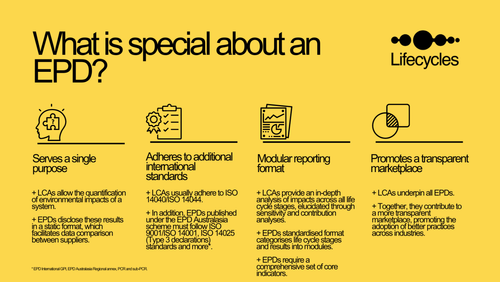
Environmental Product Declarations (EPDs), by contrast, follow a highly prescriptive framework. They are designed to communicate verified, standardised environmental information for a specific product or group of products. This structure makes EPDs particularly valuable for transparent, like-for-like comparisons between suppliers.
Key differences at a glance
Purpose
LCAs support internal decision-making by identifying environmental impacts and improvement opportunities across a system.
EPDs communicate environmental performance externally, enabling purchasers and stakeholders to compare products based on consistent metrics.
Standards and governance
LCAs must comply with ISO 14040/44 and may align with additional standards depending on the application.
EPDs published under the EPD Australasia scheme must comply with ISO 14025 (Type III declarations), ISO 14040/44, relevant Product Category Rules (PCRs), and scheme-specific requirements.
Reporting structure
Functional vs declared unit: EPDs often use a declared unit to accommodate products with multiple applications.
Life cycle stages: EPD results are reported in standardised modules, improving consistency and comparability.
Indicators: EPDs require a defined set of core environmental indicators (e.g. global warming potential, acidification, eutrophication), while LCAs can include indicators tailored to the study objectives.
Sensitivity analysis: Common in LCAs, but not applicable in EPDs, which report current product performance rather than scenario variations.
Use in decision-making
LCAs are widely applied across sectors for hotspot analysis, design optimisation, comparative assertions, and sustainability strategy.
EPDs are currently most prevalent in the construction sector in Australia, supporting architects, designers, and procurement teams to make informed, lower-impact material choices.
Why both matter
LCAs and EPDs play complementary roles. LCAs provide the analytical depth needed to understand and improve environmental performance, while EPDs translate this information into a transparent, standardised format for the market.
Together, they support credible sustainability claims, improved product design, and more informed purchasing decisions — contributing to a more transparent and environmentally responsible economy.
This article was originally published by EPD Australasia.