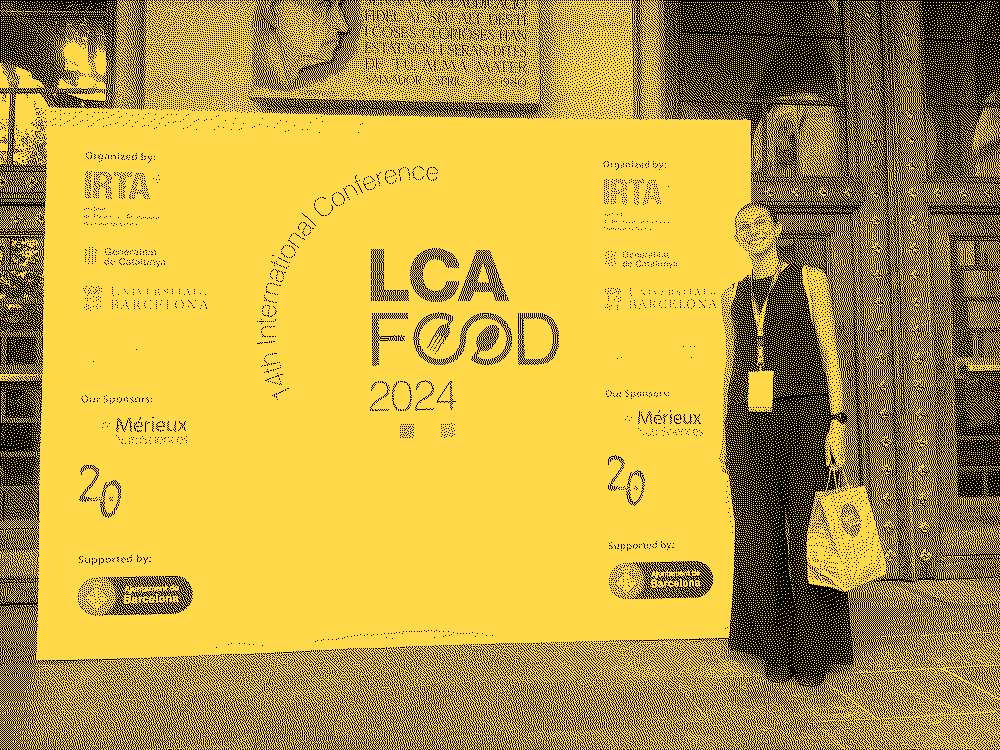
LCA Food Conference, Barcelona

Author: Dr Isobel Hume

This month, I had the incredible opportunity to spend two weeks in Spain, deepening and expanding my expertise in Life Cycle Assessment (LCA).

LCA Food 2024 Barcelona: Key Takeaways | Lifecycles

I began by completing the "From Attributional to Consequential LCA" course, hosted by Professor Bo Weidema. The course gave me a detailed understanding of consequential modelling algorithms, their data flows, assumptions, uncertainties, and applicability, as well as their compliance with ISO standards, the GHG Protocol, and EU guidelines.

Afterwards, I attended the jam-packed LCA FOOD 2024 conference. Here are just a few of my key takeaways:

⭐Transparency and Data Disclosure⭐
LCA depends on full data disclosure and transparency across the supply chain. However, transparency needs effective data-sharing mechanisms to foster collaboration between industries and stakeholders. I spoke with Cara Bea Langhorne, BSc(Eng) MPhil from Mondra about balancing aggregation, anonymisation, data accuracy, and transparency, as well as the importance of clear data quality metrics.

⭐Scalability and Data Granularity⭐
While data granularity is essential for accuracy, scalability and aggregation are crucial for large scale agri-food supply chains. Establishing minimum requirements for scalability and aggregation will be vital for LCA adoption across the industry. Thanks to Sarah Sim from Unilever for her insights.

⭐Technological Innovations in Data Collection and Integration⭐
Harnessing technology is essential for scaling up LCA and streamlining data collection. Tools that aggregate complex datasets and integrate them across platforms can significantly enhance decision-making and improve LCA accuracy. TRACE and AdAstra Sustainability presented their innovative work on quantifying GHG emissions from land use change in soy supply chains using high-resolution data.

⭐Harmonisation⭐
Harmonisation continues to be a pressing issue in LCI databases and LCIA methodologies and will only grow in importance as eco-labelling and certifications become the norm in agricultural and food products. UNEP GLAM, HESTIA, and others are leading the charge on this front.

I’m incredibly grateful to the amazing people I met and the new connections I’ve made. Special thanks to Lifecycles for this opportunity – I’m excited to apply these new insights and resources in my work!


Previous
Previous

Lifecycles launch PIQET 5.0, a revolutionary sustainable packaging tool

Next
Next

What's in the budget for sustainable agriculture?