
What is the EU Carbon Border Adjustment Mechanism (CBAM)? A guide for Australian exporters
The CBAM, established by Regulation (EU) 2023/956, is a relatively recent European Union (EU) policy aimed at preventing carbon leakage through imports, by requiring importers over certain thresholds to report and pay for the embodied greenhouse gas emissions of a range of commodities entering the Union (European Commission 2025).
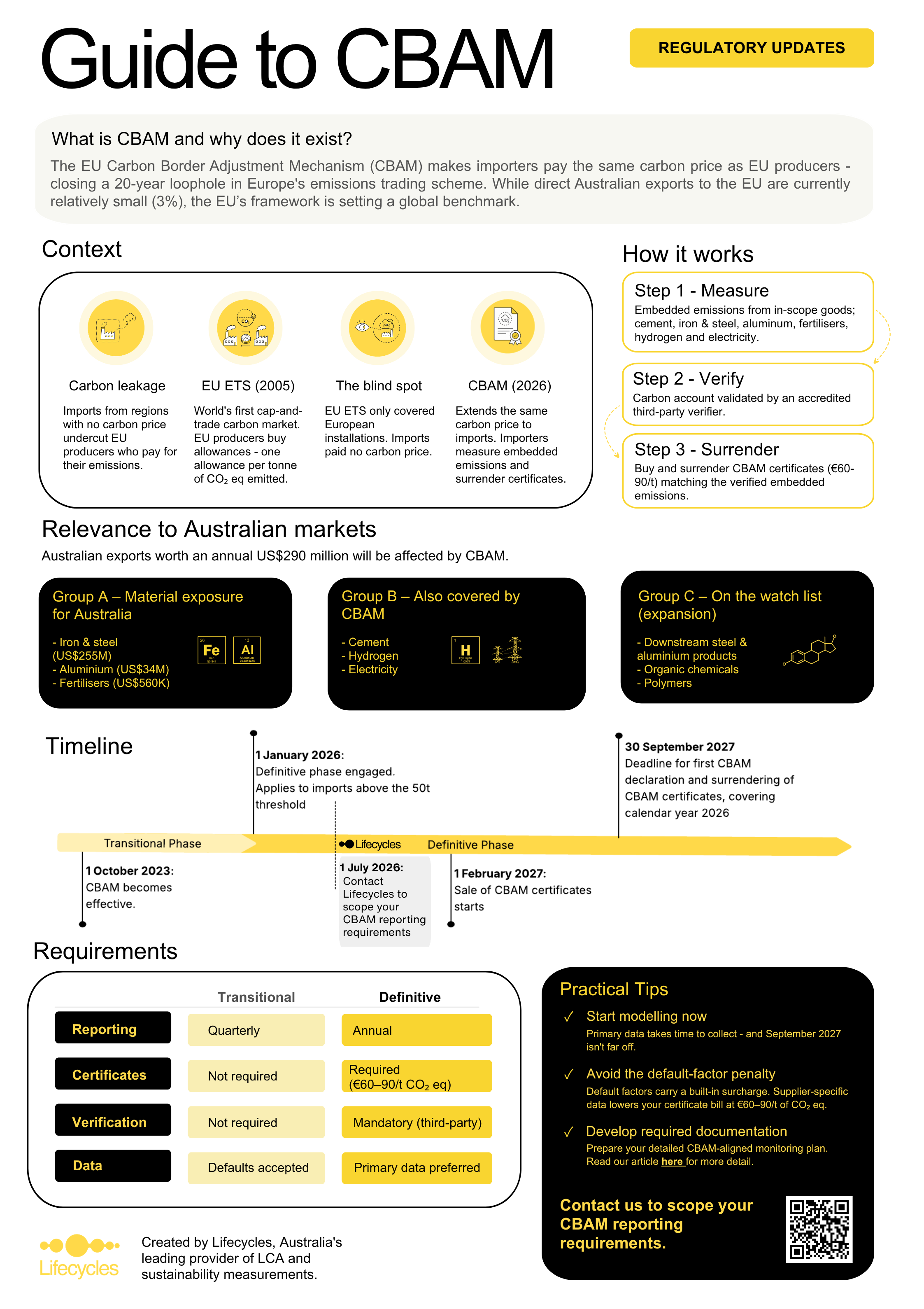
Commodities covered by CBAM include iron and steel, aluminium, cement, fertilisers, hydrogen and electricity. For Australian exporters, this represents US$ 255 million of iron and steel, US$ 34 million of aluminium and US$ 560,000 worth of fertilisers (United Nations Statistics Division 2026).
What is the EU Carbon Border Adjustment Mechanism (CBAM)?
Let’s rewind for some context. In 2005, the EU launched the first emission trading scheme, the EU ETS (European Commission 2003). At the time, it was the world first ‘cap and trade’ carbon market, and it remains the largest to this day.
The general principle of ‘cap and trade’ systems is to limit the total greenhouse gas emissions allowed from installations covered by the system (the ‘cap’). This limit is set to decrease gradually over time.
Another key concept is the notion of ‘allowance’. Under the EU ETS, one allowance provides the right to emit one tonne of CO2-equivalent. The number of allowances available on the market are aligned with the cap of all installations covered by the regulations. Some allowances are provided for free to some installations where specific performance benchmarks are achieved, but they are otherwise bought at auctions (the ‘trade’). At the end of each year, installations must surrender the number of allowances representative of their activities. If installations emitted less than their maximum cap, they are then able to trade the remaining allowances on the EU ETS.
To determine the number of allowances required, these companies must measure their direct (Scope 1) and indirect (Scope 2) emissions.
When the EU ETS was first introduced, imports were not covered, as the legislation only applied to European installations. The recent implementation of the CBAM aims to correct this blind spot, by ensuring that importers measure and surrender allowances corresponding to the embodied emissions of the imported product.
In January 2026, the CBAM entered its definitive phase. This means that Australian installations exporting to the EU will now be required to comply with this European legislation.
How does CBAM work?
In its definitive phase, the CBAM requires annual reporting by installations importing the covered commodities into the EU, once a threshold of 50 tonnes of annual import has been reached. The first mandatory reporting deadline is September 2027, by which time data representative of calendar year 2026 will need to have been produced, verified, and entered in the system, with enough CBAM certificates purchased to cover the embedded emissions of the imported products.
The CBAM regulatory document provides specific rules on the scope of work required to calculate the accounts. Key points include:
The specific greenhouse gases to include, which are reported for each product category in Annex I of the regulation
The system boundaries, which either strictly include direct emissions (Scope 1) or also include indirect emissions (Scope 2). The regulation also introduces the concept of ‘precursors’, which are input materials that are also included under Annex I of the regulation. For instance, a company manufacturing aluminium pipes from unwrought aluminium purchased from a third-party would need to include emissions from its own operation as well as of the unwrought aluminium production, calculated following the requirement of the regulation. In this case, the unwrought aluminium is considered a precursor. On the other hand, material inputs which are not covered by CBAM are excluded from the account – here, for example, emissions associated with bauxite mining operations would not be accounted for.
The embedded emissions of precursors shall be either provided by the supplier directly, or calculated from primary data, following the requirements of the regulation. If neither is possible, a default factor can be used, as provided in the regulation. Default factors include a ‘penalty’, which means they are typically higher than if calculated from specific data. This means that using default factors adds a financial penalty for importers. With certificates trading at 60-90 EUR/t, this acts as a financial incentive for the accounts to rely on specific data as much as possible.
Carbon accounts and associated CBAM certificate purchase will need to be verified by an accredited third-party.
What does CBAM mean for Australian exporters?
While currently representing a modest fraction of total export to the EU region, with approximately 3% of total value, (United Nations Statistics Division 2026), the legislation is set to increase its scope over time. Vertical expansions will include more downstream products (for instance products using high steel or aluminium contents), while horizontal expansions will focus on adding other carbon-intensive sectors covered by the EU ETS, which could include organic chemicals and polymers.
The legislation is clearly set to stay and expand over time, to support the EU’s efforts to decarbonise its economy.
For those exporters already caught by the scheme, compliance with CBAM will be a prerequisite to continue accessing the European market. For others, it is worth keeping watch on the evolution of the legislation.
How to prepare for CBAM reporting
The reported emissions will need to be verified by an accredited body to be validated. The first mandatory reporting will take place in September 2027, reporting on 2026 emissions.
To prepare, Australian exporters should begin modelling the greenhouse gas emissions associated with their products now, using the methodology set out in the CBAM regulations. Starting early allows exporters to build familiarity with the reporting requirements and assess their potential financial exposure under the scheme.
Exporters may also conduct a pre-verification of their initial estimates. This voluntary step helps test the adequacy of data collection and reporting systems, and provides an opportunity to address any gaps before the first official submission is due.
How Lifecycles can help with CBAM emissions modelling
Lifecycles is Australia’s most experienced life cycle assessment specialist consultancy. We specialise in providing sustainability measurements to businesses and policy makers. Contact us if you would like to discuss your reporting requirements under CBAM.
References
European Commission (2003). Directive 2003/87/EC of the European Parliament and of the Council of 13 October 2003 establishing a scheme for greenhouse gas emission allowance trading within the Community and amending Council Directive 96/61/EC.
European Commission (2025). Regulation (EU) 2023/956 of the European Parliament and of the Council of 10 May 2023 establishing a carbon border adjustment mechanism.
United Nations Statistics Division (2026). UN Comtrade. International Merchandise Trade Statistics. United Nations Statistics Division. New York, USA.
| CBAM requirement | What exporters need to prepare |
|---|---|
| Covered goods | Iron and steel, aluminium, cement, fertilisers, hydrogen and electricity |
| Emissions data | Product-specific embedded emissions data |
| Verification | Accredited third-party verification |
| Reporting | Annual reporting by EU importers |
| Commercial risk | Default factors may increase certificate costs |