
Climate reporting is well established. Now it’s time to take a closer look at nature. The International Sustainability Standards Board (ISSB) has recently proposed new nature-related disclosure guidance, leveraging the recently updated guidance from the Taskforce on Nature-related Financial Disclosures (TNFD) to help organisations assess their dependencies and impacts on nature. Life cycle assessment (LCA) is the practical first step to seeing where they sit across a value chain.
Why nature and why now?
Businesses depend on nature, and their operations impact it. Dependencies are the ways a business relies on healthy ecosystems, such as water, soil, pollination and timber. Impacts are the ways its activities change those ecosystems, such as land clearing, pollution and water use. As supply chains come under pressure from nature loss, these dependencies are increasingly seen as a financial risk, so reporting matters more for customers, investors and capital markets.
To map out the nature reporting landscape, there are three organisations to note:
The ISSB sets the global baseline for sustainability reporting through the IFRS Sustainability Disclosure Standards, IFRS S1 and IFRS S2.
The Australian Accounting Standards Board (AASB) adapts the IFRS S1 and S2 as AASB S1 and AASB S2 for Australian sustainability reporting.
The TNFD is a voluntary, global framework, separate from the ISSB for identifying, assessing and disclosing nature-related dependencies, impacts, risks and opportunities. It received foundational funding from the Australian Government (DCCEEW 2026).
On 22 October 2026, the ISSB released an exposure draft of the IFRS Sustainability Disclosure Practice Statement 1 Nature-related Disclosures (the Practice Statement) (IFRS 2026). The draft is open for comment until 19 February 2027, and the ISSB will redeliberate before finalising it. If finalised, the Practice Statement would be non-mandatory: organisations could comply with ISSB Standards without applying it, although jurisdictions could choose to require it.
The Practice Statement is intended to support organisations applying IFRS S1 General Requirements for Disclosure of Sustainability-related Financial Information, the standard on which AASB S1 is based. It draws on the TNFD framework and refers to the TNFD’s recently updated Locate, Evaluate, Assess and Prepare (LEAP) approach version 2.0 (TNFD 2026) as a way to identify and assess nature-related impacts and dependencies, although using LEAP is not required.
Why this matters for Australian businesses
In Australia, currently only the climate-related reporting (AASB S2) is mandatory, while the general sustainability standard (AASB S1) is voluntary. However, because the AASB Standards follow the global baseline of the ISSB/IFRS standards, the developments in these global frameworks could translate to increased reporting requirements for businesses, although this has not been indicated yet.
A quick look at AASB S1
AASB S1 outlines the requirements to disclose information on all sustainability-related risks and opportunities that could reasonably be expected to affect the entity’s cash flows, its access to finance or cost of capital over the short, medium or long term (AASB 2024). The standard is broad, covering environmental, social and governance (ESG) topics.
S1 follows the same four-pillar approach as S2: governance, strategy, risk management and metrics and targets. The key difference is in how topics are chosen. S2 is prescriptive about climate with requirements such as Scope 1, 2 and 3 emissions and scenario analysis. S1 leaves topic selection to the business, based on its own materiality assessment.
In practice, preparing an S1 report involves a few connected steps:
Map your value chain to understand your dependencies on resources and relationships.
Identify the resulting sustainability risks and opportunities using international sustainability standards. [1]
Apply financial materiality to select the topics that could affect cash flows, access to finance or cost of capital.
Prepare disclosures for each material topic under the four pillars, and connect them to the financial statements.
Build the data systems and controls needed for repeatable, assurance-ready reporting.
The first step, understanding your value chain, underpins everything that follows. This is where LCA comes in.
LCA as a tool for nature reporting
The TNFD’s LEAP guidance lists LCA among the tools organisations can use to map their value chains and estimate their impacts on nature (TNFD 2026). LCA supports the early stages of both S1 preparation and nature-related assessment.
Specifically, LCA is a helpful tool to:
Map the value chain. Using financial or direct activity data, LCA assesses an organisation’s products and services to show which upstream suppliers, downstream users and markets they connect to.
- Identify hotspots. LCA shows where in the value chain the largest pressures on nature are likely to sit, so that more detailed site-level work can be targeted where it matters most.
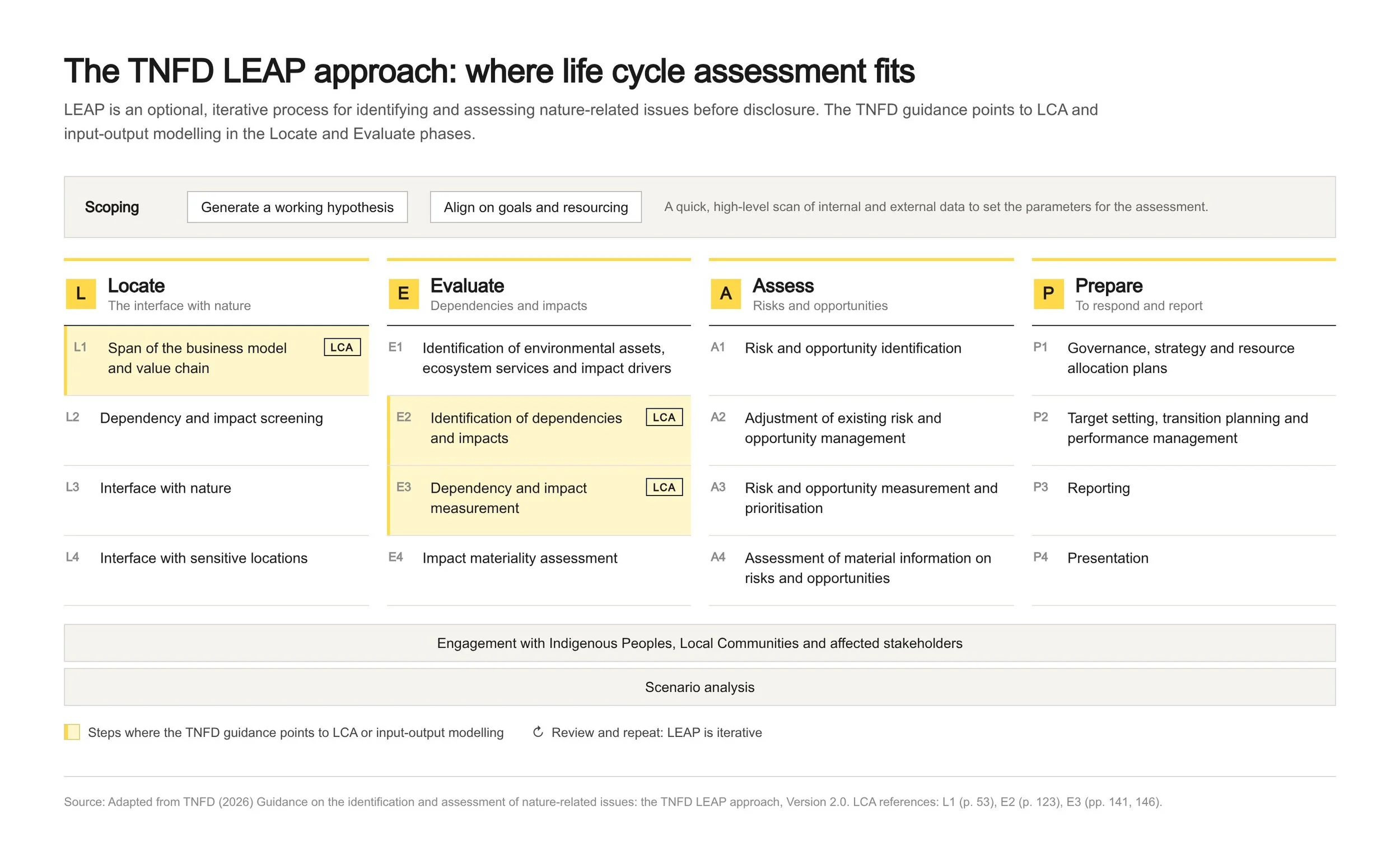
Figure 1 shows the four phases of the LEAP approach and the three steps where the TNFD guidance points to LCA or input-output modelling: understanding the span of the business model and value chain (L1), and identifying and measuring dependencies and impacts (E2 and E3).
The draft Practice Statement would also ask organisations to consider the location of their assets and activities across the value chain, and to disclose the amount and percentage of assets or business activities vulnerable to nature-related risks and aligned with nature-related opportunities. LCA does not replace location-specific assessment, but it shows where to focus it.
How Lifecycles can help
We help organisations build value chain models that serve both climate and nature reporting, drawing on Australian data from the AusLCI database, which we help develop and maintain. Whether you are looking to commence or expand on your sustainability reporting, we can meet you wherever you are on the journey. Contact us to talk it through.
This article provides general information only and does not constitute legal, financial, or accounting advice. It is current as at November 2026.
[1] AASB S1 and IFRS S1 requires companies to refer and consider the applicability of the Sustainability Accounting Standards Board (SASB). An explainer of the interaction of how these standards interact can be found here.
References
Department of Climate Change, Energy, the Environment and Water (DCCEEW) (2026) Investing in nature. Available at: https://www.dcceew.gov.au/environment/environmental-markets/investing-in-nature
International Sustainability Standards Board (ISSB) (2026) Exposure Draft ISSB/ED/2026/1: IFRS Sustainability Disclosure Practice Statement 1 Nature-related Disclosures. London: IFRS Foundation. Available at: ifrs.org
Taskforce on Nature-related Financial Disclosures (TNFD) (2026) Guidance on the identification and assessment of nature-related issues: the TNFD LEAP approach, Version 2.0. Available at: tnfd.global