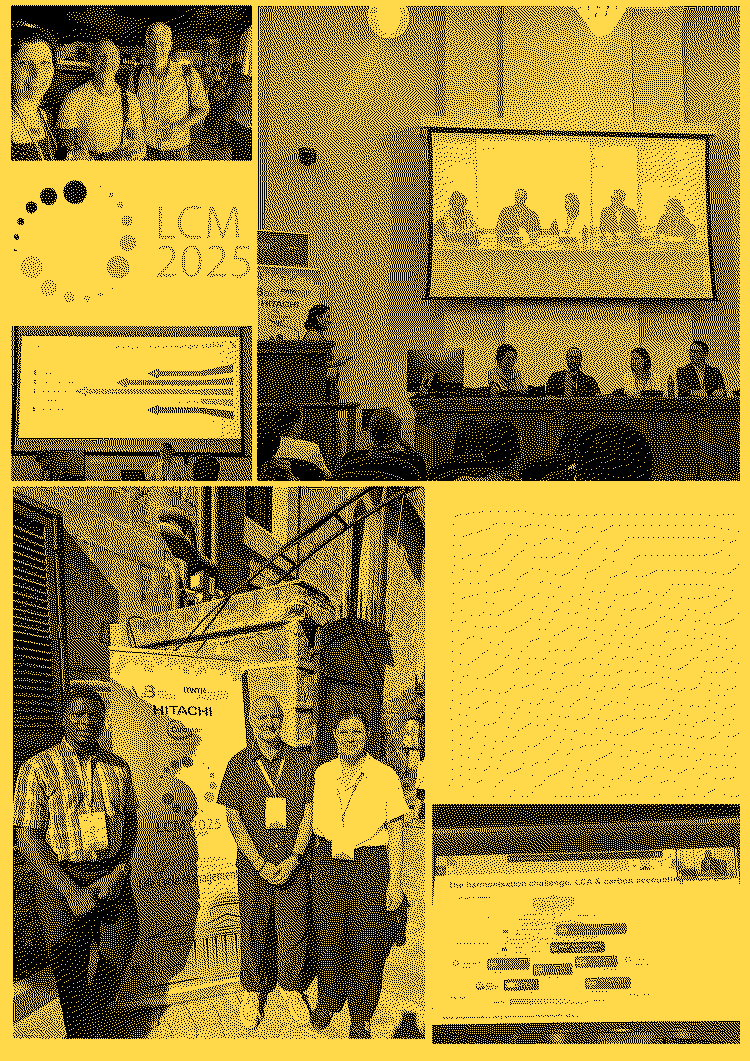
Two weeks ago, I had the privilege of attending LCM 2025, a conference that made one thing abundantly clear: Life Cycle Assessment is at a crossroads. Over three intensive days, industry leaders, policymakers, and practitioners converged to address a field experiencing what the EU Commission aptly called an "identity crisis."
Day 1: The automation imperative
The opening day established the central challenge facing LCA practitioners today: the traditional approach is broken. PRé Sustainability's Marisa Vieira captured it perfectly—"LCA experts have become the main bottleneck."
The solution? A fundamental shift from "lots of manual work and little expert input" to "lots of expert input and minimal manual work." As Sophie Kieselbach emphasised, "we have the technology, we just need to stop being scared to use it"—though she rightly noted that "a tool is only as good as the person who trained it."
Real-world applications are already emerging. Schneider Electric's AI-powered management of over 500,000 products through Makersite demonstrated both AI's potential and its pitfalls, while IPOINT's dynamic BOM mapping showcased solutions to data collection challenges—emphasising the crucial role of sample checks in building expert trust in AI systems.
Data collection remains a persistent pain point. Companies store information across Excel, APIs, and various portals, making standardisation crucial. As Andrea Charrier noted, current data management systems were built before LCA and EPD needs existed and are no longer fit-for-purpose.
Perhaps most striking was An De Schryver's call to action: "Do we keep turning in circles or do we move forward in one united direction?" The consensus was clear—harmonisation is no longer optional.
Day 2: Policy meets practice
Day two brought heavyweight keynotes from the EU Commission and UNEP, signalling LCA's transformation from academic tool to mainstream policy instrument. Mauro Cordella from the EU Commission didn't mince words, showing a slide of the fragmented landscape and declaring "this is a big mess." With over 100 standards and labels for steel alone, his message was urgent: after 40 years, LCA has reached maturity and is now facing its moment of truth.
UNEP's Archana Datta highlighted a critical gap in global capacity, particularly in developing countries and the global south. Her proposal for a Global LCA Platform addresses the urgent need for harmonised data, unified methodology, and interoperability between tools and platforms.
Throughout the day, speakers issued powerful calls to action. Schneider Electric's William Lepercq emphasized the need for comparability frameworks now, while we have the attention of markets and policymakers. Philippa Notten from TGH Think Space NPC advocated for integrating social elements into LCA within policy contexts—challenging but essential for catalysing uptake.
Marisa Vieira made a compelling case for making LCA "sexier" and improving communication around its value. Her vision for the path forward centred on fit-for-purpose tools that enable non-expert decision-makers to access standardized yet context-specific methodologies without compromising scientific rigor. Configurable models using archetypes, she suggested, could act as skeletons to build from, catalysing greater data availability.
The day's message was unmistakable: the industry is ready, the technology exists, and legislation can be a powerful tool for harmonisation. What's needed now is collective will.
Day 3: Beyond traditional boundaries
The final day pushed the boundaries of what LCA can become, integrating planetary limits with social justice and economic realities.
Xue Sun from Empa and ETH Zürich delivered a standout presentation on "Downscaling the Doughnut"—a sufficiency-based approach that defines a universal basket of materials necessary for decent living standards, then uses LCA to quantify ecological impacts. The framework's critical insight? Even essentials can overshoot planetary boundaries, highlighting the need for absolute sustainability rather than just relative improvements.
Teddy Serrano from DTU Sustain challenged conventional thinking on science-based targets, distinguishing between "how you make it versus what you make it for" and "eco-efficiency versus eco-effectiveness." Meanwhile, Johannes Zobel from the University of Augsburg questioned whether Scope 3 emissions calculations actually drive reduction, demonstrating that bottom-up data enables decarbonization while top-down data merely enables accounting.
Data management took center stage again, with Martin Baitz from Sphera questioning whether we should extend databases at the expense of accuracy and advocating for "supply chain digital twins" that enable multiple methodological applications. Tomas Rydberg from IVL suggested learning from financial institutions' centuries of experience, proposing we mimic financial accounting principles in environmental assessment—though noting LCA's superior uncertainty handling could teach economics a thing or two.
The road ahead
Three days at LCM 2025 revealed a field in transformation. We're moving beyond traditional LCA toward integrated sustainability assessment that addresses planetary boundaries, social justice, and economic realities simultaneously. AI and configurable models will democratise LCA while maintaining expert knowledge at its core.
The question isn't whether this transformation will happen—it's how quickly we can implement it responsibly. The tools exist, the frameworks are emerging, but implementation requires unprecedented coordination across disciplines and industries.
As the conference concluded, one truth remained: the future of sustainability assessment isn't just about measuring environmental impacts—it's about creating frameworks that guide us toward a just transition within planetary boundaries.